The Gnostic Serpent and The Divine Feminine
The Christian
Gnostics practiced a spirituality more similar to Eastern traditions
than to the Western Christianity we know today. “Gnostic” is Greek for
“knower” and it is “Gnosis” or “Knowledge” that they were seeking.
Unlike the blind faith demanded by today’s Churches, ‘Gnosis’ meant
direct, mystical experience of the divine, which was to be found by
individual spiritual evolution to Self-Realisation, and not within the
confines of intellectual dogma. The experience of Gnosis was
trans-rational and non-intellectual. 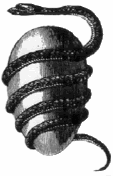
From the Nag Hammadi Library, the Book of Thomas, Christ tells us “For
whoever does not know self, does not know anything, but whoever knows
self, already has acquired knowledge about the depth of the universe”.
Compare this with a tract from the Upanishads, the Indian metaphysical
treatise on Self Realisation: “It is not by argument that the self is
known… Distinguish the self from the body and mind. The self, the
atman, the highest refuge of all, pervades the Universe and dwells in
the hearts of all. Those who are instructed in the self and who
practice constant meditation attain that changeless and self effulgent
atman ( spirit/ self). Do Thou Likewise, for bliss eternal lies before
you…” In another gnostic text, the Secret Gospel of Thomas,
Christ promises us spiritual fulfilment “I shall give you what no eye
has seen, what no ear has heard, what no hand has touched and what has
never arisen in the human mind.” This description is not unlike the
Upanishadic experience “the Self is devoid of birth and death, it
neither grows old nor decays and the accidents of life do not affect
it. The Self transcends space and time; what is great is not too great
for it to comprehend and what is small is not too small to escape its
attention. It is the Self of All”. Just as Christ warned us
against sin and encourages moral perfection in the pursuit of spiritual
fulfilment, so too do the Eastern texts “No intellectual acumen can
help one realise it, it can be realised only by those who surrender to
it and who make themselves worthy by grace, by desisting from all that
is sinful, who engage in the practice of perfection by constant
meditation”( Upanishads). The most ancient Eastern spiritual
texts, the Vedas,of India, tell us that the process of spiritual
awakening by which one attains truth -awareness is called
‘Self-Realisation’. The Self Realised person lives in direct experience
of reality — this is called “Jnana” ( a traditional sanskrit word
meaning ‘knowledge’ or ‘Gnosis’). Such a person is called a “Jnani”
(‘knower ‘ or ‘gnostic’ ) or “dwijaha” (‘twice born’; first from a
human mother to the earthly plane then secondly as a child of the
Goddess, or Divine Mother, who gives the seeker their second, spiritual
birth, Self Realisation, into the plane of mystic awareness- gnosis! ).
The traditional Indian texts extol the ‘Divine Mother’ as the Cosmic
Matriarch, bestower of the highest treasure of Self Realisation upon
Her deserving children. Many Indian mystic traditions say this same
goddess is represented within the human being as the divine feminine
power called Kundalini. 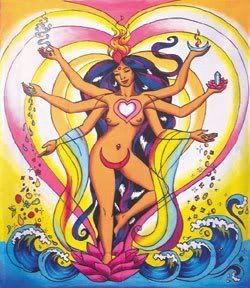
What of Western tradition? In the Secret Book of John Christ explains
that human redemption before the Heavenly Father occurs by the
mediation of a Divine Feminine principle, which he calls the Earthly
Mother. It is the Earthly Mother who removes the sins of the children
that they can become worthy of their divine heritage; “when all sins
and all uncleanesses are gone from your body, your blood shall become
as pure as our Earthly Mother’s blood and as pure as the river’s foam
sporting in the sunlight. And your breath shall become as pure as the
breath of odorous flowers; your flesh as pure as the flesh of fresh
fruits reddening upon the leaves of trees; the light of your eye as
clear and bright as the brightness of the sun shining upon the blue
sky. And now shall all the angels of the Earthly Mother serve you and
your breath, your blood, your flesh shall be one with the breath, the
blood and the flesh of the Earthly Mother, that your spirit also become
one with the Spirit of your Heavenly Father. For truly no-one can reach
the Heavenly Father unless through the Heavenly Mother. Even as the
newborn babe cannot understand the teaching of his father until his
mother has suckled him, bathed him, nursed him, put him to sleep and
nurtured him”. The Earthly Mother is a divine mediator through which
the seekers, the Sons of Man, are raised to the Heavenly Father.
Another part of the same text says “Honour your Earthly Mother and keep
her laws that your days may be long on this earth and honour your
Heavenly Father, that eternal life may be yours in the Heavens. For the
Heavenly Father is a hundred times greater than all the fathers by seed
and by blood, and greater is the Earthly Mother than all mothers by the
body”. The Holy Trinity, then is God the Father, God the Son (ie.
Christ) and, it seems, God the Mother. The Divine Mother particularly
is the means and power of spiritual evolution. The Secret Book
of John relates Christ’s description of the Divine Feminine as the
power of God Almighty. “She is the first power. She preceded
everything, and came forth from the Father’s mind as forethought of
all. Her light resembles the Father’s light; as the perfect power She
is the image of the perfect and invisible Virgin Spirit. She is the
first power, the glory, Barbello, the perfect glory among the worlds,
the emerging glory, She glorified and praised the Virgin Spirit for she
had come forth through the Spirit. She is the first thought, image of
the Spirit. She became the universal womb, for She precedes everything,
the common parent, the first humanity, the Holy Spirit”. The Holy
Spirit is here described as the Divine Power of God Himself. This power
is maternal in its character (universal womb, She, the common parent)
and all powerful as the ‘first emanation of God’. More so, She is pure
(Virgin) and She glorifies purity. So ancient christian tradition seems
to tell us that the holy spirit is actually the Divine Mother!
One cannot overlook the Eastern parallels. God Almighty in Indian
mythology is represented as Sada-Shiva. His state is eternal perfection
(Sat Chit Ananda). His power is the Adi Shakti (primordial power) who
is His feminine counterpart or spouse. It is She who does all things.
She created the universe and the gods who attend over it (for example,
the triune Shiva, Brahma, Vishnu). The Adi Shakti is the Mother of all
things. She gave birth to the universe and is the feminine power of
every deity and celestial being (usually represented as their spouse).
The Secret Book of John parallels this “She became the universal womb,
for She precedes everything, the common parent, the first humanity, the
Holy Spirit, the triple male (Shiva, Brahma, Vishnu?) the triple power
(Parvati, Saraswati, Lakshmi, who are spouses of the triple males-or
the triple Goddess of Western mythological tradition?)”. Thus the
Christian mystics understood that the Holy Spirit is the Divine
Feminine, the Goddess, the Universal Mother herself. The Syriac
Christians worshiped the Holy Ghost as the Great Mother. Phillip
suggests that Mary Herself is the Holy Spirit (for who else but God the
Mother can give birth to God the Son?). Other Apocryphal Scriptures
describe Mary as the focus of Temple activities. Her early life was
punctuated by auspicious portents all implying her own Divinity.
Just as Mary and the Holy Ghost appear to parallel aspects of the
Divine Mother described in the East, so too does Christ, the son of God
reflect the Eastern principle of the Divine Child. The Divine Child in
the Eastern mythological tradition is commonly worshiped as the dual
child-gods Ganesha and Kartikeya. Ganesha represents the fabric of the
cosmos, the primordial Aum or Logos from which the creation was
constructed. Christ affirmed the same primordial nature of himself when
he said “I am the first” and “I am the alpha”. Ganesha is the
primordial child who is the embodiment of purity and innocence.
Similarly Christ venerated children and the innocence that they
manifested. He even urged the apostles (and us) to cultivate our own
childlike innocence ” let the children come to me for the kingdom of
heaven belongs to such as these” and “assuredly whoever does not
receive the kingdom of god as a little child will by no means enter
it”(Mark 10). Kartikeya is the same principle of innocence in dynamic
action- the slayer of evil; as Christ did when he ejected the money
lenders from the temple. So, Christ seems to be telling us
that the kingdom of Heaven, which is a state of God-like perfection and
child-like innocence is attained by some inner phenomenon. In the
Gnostic Scriptures Christ spoke directly of this as an inner
transformation, self realisation. He also told us that the Holy Ghost
or Divine Mother is the power by which this is accomplished, but by
what mechanism? Let’s take lateral look at the Indian
tradition of Kundalini of which many local saints have spoken.
Shankaracharya (700AD) and Gyaneshwara (1200AD) are two well known
mystic exponents of Kundalini. They both describe the actualisation of
self-realisation in their classic poetry, such as the Saundarya-Lahari,
Sivananda-Lahari and the Gyaneshwari (itself a commentary on the
Kundalini Yoga described by Krishna in the Bhagavad Gita ). They
describe a force of pure (virgin) spirituality, which lies dormant
within the human being. By constant purification and self
perfection the seven vital energy centres (chakras) which govern all
aspects of mind, body and soul, are prepared for the awakening of
Kundalini. Once awakened by divine grace, the Kundalini passes through
these centres, not unlike a string through beads, enlightening each as
it passes through. Arriving at the seventh centre (Sahasrara) the
seeker’s awareness is united with the eternal-self-within. The
experience is transrational, non causal, a tangible and real bliss of
truth-awareness. Indian mystics called the Sahasrara “Paradise”,
“Heaven” or, as Christ has called it “The Kingdom of God Within”. As
the Kundalini passes through each of the vital centres, they are
stimulated to produce a pure, nourishing energy. The Vedas (Ancient
Scriptures of India) describe this energy as a sacred river emitted by
each of the seven chakras. Shankaracharya called this energy “spun”. He
too described its nature as being like divine water showering down upon
him as he meditated in the ecstacy of devotion. Other Indian scriptures
call this energy “Paramchaitanya” (energy of supreme consciousness).The
miracle of Whitsunday wherein the Apostles became empowered with their
spirituality sounds similar to the experience of these chakras
manifesting this same divine energy. Shankaracharya said “All
Glory unto the current of Divine Bliss which, brimming from the river
of Thy Holy stories, flows into the lake of my mind, through the canals
of intellect, subduing the dust of sin and cooling the heat of memory”.
Much of the gnostic texts repeat this ancient Eastern understanding.
Consider this tract from the Book of Hymns of the Dead Sea Scrolls: “I
have reached the inner vision and through Thy Spirit in me I have heard
Thy wondrous secret, through Thy mystic insight Thou hast caused a
spring of knowledge to well up within me, a fountain of power, pouring
forth living waters, a flood of love and of all embracing wisdom, like
the splendour of eternal light”. The “fountain of power”, “spring of
knowledge”, “Living water”, “flood of love”, “eternal light” all
directly describe the experience of Kundalini awakening! Consider this
from the Nag Hammadi Library, the Apocryphal Gospel of Phillip “The
Tree of Life is in the centre of Paradise, as is the oil tree from
which the anointment Chrisma comes. The Chrism is the source of
resurrection”. Krishna, the divine being, c4000BC, also described the
Kundalini as an inverted Tree of spirituality, whose roots lay in the
brain. The ‘Tree of Life’ is a well recognised symbolic parallel of the
Kundalini. So too is the Holy Grail, the cup from which Christ drank at
the last supper its symbolic significance being that Christ’s
sustenance arose from a cup, that is, an object whose receptive
qualities reflect the nature of the divine feminine — yet another
parallel of the Kundalini. 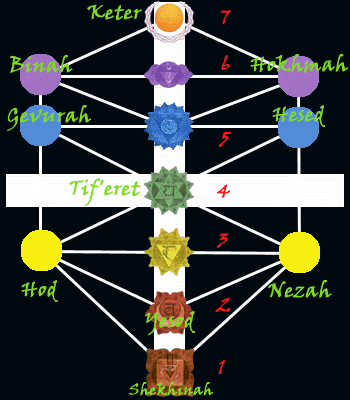
It is likely that St Phillip’s ‘Chrisma’ is the same ‘spun’ described
by Shankaracharya, the ‘Paramchaitanya’ or in Christian terminology
‘God’s grace’. In the Gospel of Peace, Christ explains that the
experience of spirituality is foremost. He says the Scriptures are
merely conveying an intellectual knowledge, but we are to have the
‘living knowledge’, that is the experience of our own spirituality. He
says “Seek not the law in your Scriptures for the law is life, whereas
the Scripture is dead. I tell you truly Moses received not his laws
from God as writing but through the living word. The law is living word
for living God to living prophets for living men. In everything that is
life to the law is the law written, for I tell you truly all living
things are nearer to God than the Scripture which is without life. I
tell you truly that the Scripture is the work of man, but life and all
its hosts are the work of our God. Wherefore do you not listen to the
words of God which are written in his works? And wherefore do you study
the dead Scriptures which are from the hands of men?”. That is, seek
the divine experience which is beyond definition, do not settle for
mundane human interpretations of the mystic’s suprahuman experience.
Thus Christ’s law is a living, cosmic and experiential one, and is
actuated by the awakening of the spiritual experience within the
seeker, not by intellectual study or by following those who themselves
have not truly had the experience. This directly parallels the eastern
teachings; that self- realisation, the pure spiritual awakening, is
attained by the righteous and itself gives greater righteousness. More
so, self realisation is a process of genuine, inner spiritual
transformation which must be experienced to be understood, since it
lies beyond the domain of scriptural description or theological
definition. Since it is gained by the grace of the Divine Mother( Holy
Spirit) alone, it is most certainly not possible to organise or
institutionalise this experience in human terms. This
contrasts with the way in which the Churches have pigeonholed and
categorised Christianity in terms of ‘blind faith’, ‘obedience to the
church’ and empty ritual. In the Gnostic Scriptures, untouched by the
organised churches, Christ urges us to perceive and experience the
cosmic order for ourselves and not to rely on so-called scriptural
authorities — such as the churches — to prescribe it to us.
C.G. Jung recognised the link between the Divine Feminine and the
Eastern principle of Kundalini. He understood that the Kundalini was
the representation of the Goddess within each of us. Is the Holy Ghost
the Kundalini? Was the Kundalini a central principle in early mystic
Christianity? Such an assumption would help us reinterpret many parts
of the mainstream bible, for example; In the Gospel of John, Christ
explains to the Pharisee Nicodemus, ” Verily I say unto thee, except a
man be born of water and the spirit; he cannot enter the kingdom of
God”, this second birth far from being a licence for so many born again
Christian fundamentalists is something much more mystical and subtle in
nature. To be “born of the water and the spirit” describes the
awakening of Kundalini. She is often described as a divine mother whose
ascent within the spine of the seeker gives them rebirth into
mystic/gnostic awareness, the ‘divine water’ is its nourishing energy.
The Kundalini enters the Sahasrara and there unites the seeker’s
awareness with the self or spirit. This is described as a blissful,
infinite experience of the kingdom of God within. Thus, Christ’s ‘born
again’ Christianity might actually refer to those Christians who have
entered the realm of direct experience of divinity, in the state of
self realisation. Other Canon (mainstream) Scriptures can be
more deeply understood in this light. In the Gospel of Matthew, Christ
says “Be Ye Perfect, even as Your Father which is in Heaven is
perfect”. (Ch.5, v. 48). This is a clear exhortation by Christ to
strive and achieve spiritual perfection, just as the Buddha and other
Eastern sages taught their disciples. Christ tells us about our
innately divine nature “Ye are Gods” (Psalm 82, v.6; John 10, v.34).
Furthermore “Behold the Kingdom of God is within you” (Luke 17, v.21),
that is the experience of Heaven is an internal phenomenon. This
implies that the inner state of the seeker is the source of their
spiritual fulfilment. We could well say that Christ’s idea of Heavenly
Salvation was an internal state of Godlike perfection. When
the seeker’s awareness is completely united with the Eternal
Spirit/Self/Atman the true self (not ego, mind, intellect, personality,
body or memory) is experienced or realised. Since the spirit is no less
than a reflection of God itself then in the state of complete Self
Realisation the seeker experiences perfection” as our Father in Heaven
is perfect”. The Eastern term for this state of Self Realisation is God
Realisation and it represents the final stage of our spiritual
evolution. There are deeper references to the chakras and
kundalini in the Scriptures. For example, Revelations may also
symbolically describe the chakras in St. John’s spiritual vision;” I
saw seven standing lamps of gold” (the chakras emitting the divine
light?), John sees Christ as one of the seven lamps (you will see the
significance of this later), Christ is holding the “seven stars”
(demonstrating his command of the chakra system?) and speaks of the
“seven churches” (the divine institution within each chakra?).In
Genesis Jacob envisions a divine ladder directly connecting his earthly
being with God in Heaven- this precisely describes the experience and
purpose of the kundalini! Consider this idea: The term ‘Jesus
of Nazareth’, does not (say German theologians) relate to Christ’s
times in Nazareth. Proper understanding of the original language shows
that such a term is not linguistically possible (despite the fact that
Paul uses it). The original term is more likely, “Jesus the Nazareen.”
Nazareen is an Aramaic word meaning “one who has bound himself to the
service of God” or “one who is anointed.” Compare this to the meaning
of Yoga, “Union with God” and ‘Yogi’ one who has union with god or to
descriptions of the awakening of the Kundalini, “the mystical
anointment”. The Nazaria were a group of Gnostics contemporary to
Christ. They taught a mystic spirituality similar to the Eastern ideas
already described. It has been suggested by some authorities that this
Gnostic word is ultimately derived from the Hindustani ‘Nazar.’ This is
a yogic term for the point between the eyebrows and above the nose (the
‘third eye’) where sages of old performed meditation. ‘Nazaren’ means
to envision or behold. Then a more accurate meaning of “Jesus the
Nazareen” would be “Jesus who has Yoga or Self Realisation” or “Jesus
who meditates”. Considering Christ’s status as the” Son of God” perhaps
a more appropriate meaning would be “Jesus who is the object of
meditation”. Was Christ himself the object of meditation as are many
deities in Eastern cultures? Christ himself might well be the Nazaren.
The Nazar physically corresponds to the location of the Agnya chakra,
the sixth vital chakra through which the Kundalini must pass before She
enters the Sahasrara. The Agnya manifests physically as the ‘optic
chiasm’ whose shape itself is cruciform! Is the cosmic Christ
represented within each of us in the Nazar, Agnya chakra, just as the
cosmic Mother or Holy Ghost is represented within us as the Kundalini?
The position of the Agnya chakra is such that it is the final centre to
be crossed before the Kundalini finishes its journey to the Sahasrara (
the ‘Kingdom of God Within’). Entry of the Kundalini into the Sahasara
gives the blissful experience of divine awareness. This literally
explains Christ’s words, “None can enter Heaven except through me”.
Ponder also on Christ’s instruction ‘to be as little children’ or “look
at the birds of the air for they neither sow nor reap nor gather into
barns; yet your heavenly father feeds them….which of you by worrying
can add one cubit to his stature?”(Matthew 6). The innocence of mind
which he describes is that same Zen awareness obtained in the state of
meditation, when the Agnya chakra is pierced by the Kundalini giving
rise to a heightened awareness of the present moment, all thoughts of
past and future neutralised. Consider also that Christ himself told us,
“When your two eyes become one, your body will be filled with light.”
This implies that when we go beyond the physical sight ( the two eyes)
to the subtle experience or perception which occurs by opening of the
third eye and thus entry of the awareness into the Sahasrara our body
is filled with light, purity, grace etc. There is further
symbolism eg. the twelve apostles represent six pairs which are
symbolic of the lower six chakras from Mooladhara to Agnya. These six
chakras are limited to dual awareness, ie. past and present, cause and
effect. However, the final chakra, Sahasrara, represented here by
Christ, who was the leader of the twelve apostles is non-dual, being
derived from an awareness higher than the causal plane. Here
are some possible conclusions which are equally reasonable, though
entirely contrary to modern dogma about Christ and Christianity.
Christ’s spirituality differed radically from our modern understanding.
His teaching was dynamic and zen-like focusing on the experience of
inner purification and transformation, the elevation of the seeker’s
awareness into the state (not concept or dogma) of self-realisation. He
sought to overthrow the immoral culture of the Romans and to deliver to
the dogmatic, letter-bound Jews the mystic fulfilment promised to them
in the Mosaic covenant. Central to his teaching was the
understanding that the feminine aspect of God, God the Mother, was the
means by which self-realisation and spiritual evolution to
god-awareness occurred. Christ venerated the Divine Mother as the Holy
Spirit. It is this power, described in the East as residing in the
human being as the Kundalini, that is the last vestige of the
Goddess-tradition in the Christian West. Mary was in her own
right a divine being. She was venerated as such by Christ and some of
the suppressed scriptures describe her as the Holy Spirit incarnate. 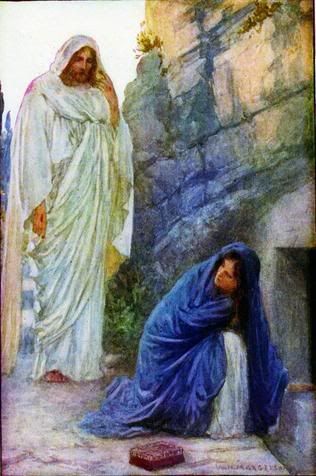
Why did the Churches suppress these true christian traditions? Partly
because they are patriarchal institutions based on the questionable
dogma of Paul who perceived women (and therefore the feminine
principle) as inferior entities. Partly also because spirituality which
focused on the Divine Feminine would also focus on the redemptive power
of God the Mother and on Her role as the grantor and matriarch of
mystical experience. This kind of understanding, like all mystics and
mysticism, defies organisation, dogmatic hierarchies and institutions
preferring the role of individual experience, revelation and
progressive growth toward divine awareness. The Holy Ghost,
then, threatened to neutralise the fear-oriented dogma which the
Churches have used, in the name of Christ and Spiritual Truth, to
maintain their secular power and wealth. Christ’s promise of a
comforter, the “second coming”, implies another divine incarnation to
bring about the redemption of humanity. As we have seen it is the
Divine Mother who has the power to redeem her children, the Sons of Man
(as the gnostics put it), in the eyes of God the Father. Who better to
comfort the children who suffer, as does the West and much of the world
from a culture whose ethic of materialism and immediate gratification
is characterised by terms such as “the lost generation”,
“eco-disaster”, “terrorism”, “future shock” and “psycho-social
alienation”, than the Divine Mother? C.G. jung, in his
critique of the Western psyche keynoted the absence of the Feminine
Principle as a major cause of much of the West’s psycho-cultural
imbalance. The return of the Divine Feminine would indeed facilitate
the spiritual redemption of Western Culture. With this perspective we may be able to understand a key image from Revelations;
“A great Portent in Heaven, a Woman robed with the Sun, beneath her
Feet the Moon, and on her Head a Crown of twelve Stars. She was
pregnant, and in the anguish of Her Labour She cried out to be
Delivered. Then a second Portent appeared in Heaven: a great red Dragon
with seven Heads and ten Horns; on his Heads were seven Diadems, and
with his Tail he swung down a third of the Stars in the Sky and flung
them to Earth. The Dragon stood in front of the Woman who was about to
give birth, so that when Her Child was born He might devour It. She
gave birth to a male child, who is destined to rule all the Nations
with an Iron Rod…..” 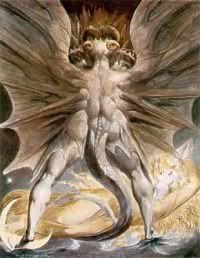
The Divine Woman, a central figure of Revelations, is the Comforter
Herself. The crown of stars indicates that Her authority and heritage
is of the Divine Father, the moon, upon which She resides is another
symbol of the feminine. As the Divine Mother She is giving
birth, ie. self-realisation, and succeeds in producing a man-child. A
man indicating spiritual maturity and dynamic action and yet a child
symbolising purity of heart and that quality of innocence which Christ
taught was essential to enter into the state of Heavenly Experience.
The child, having the mystic awareness of self-realisation, rules over
the nations indicating command of the earthly plane as well as over the
inner country, the chakra system. The child of the Divine mother is a
Gnostic adept! He rules with an iron rod, the kundalini, which
mercilessly slays the forces of evil, the obstacles which obstruct her
flow through the chakra system. The dragon who stands over the
Woman as She labours waiting to devour the child could well be the
Churches. Their 2000 year vigil against the Divine Feminine lest she
produce a race of Gnostics is evident in their manipulation and
suppression of the scriptures. Revelations tells us that the Divine
Children are destined to overcome the beast and establish a New Age of
divine awareness. Consider Christs warning “he who has
blasphemed against the holy ghost shall be damned forever”. What then
of the Churches who have virtually edited the divine feminine out of
the Western Cultural tradition in order to maintain their grip on the
masses?  Copyright Knowledge of Reality Magazine 1996-2005.
